INSTALLATION / REPAIRS / UNDERSTANDING YOUR SYSTEM
Gas line
installation.
Understand the whole system.
From stoves and dryers to boilers, fireplaces, pool heaters and generators: learn what a gas-line project involves, then plan the supply around your home and equipment.
New gas lines, extensions and repairs in Sandy and the Salt Lake Valley. We explain the pipe route, price and inspection plan before work begins.

See this project and its photos ↗
Long story short
We install, extend and repair gas lines for ranges, dryers, heaters, fireplaces and outdoor appliances. We plan the pipe route, capacity, testing and required inspections around your equipment. Tell us what you're adding or changing.
Jump to: Understand the job. Know the next step · Gas lines, one idea at a time · Where is the new line going · Will the existing line handle the new appliance
Skip the read? Book a visit or text (385) 766-8935.
YOUR GAS LINE HUB / START ANYWHERE
Understand the job.
Know the next step.
Follow the gas from the utility supply to your appliances. These guides cover who maintains each part, how pressure and pipe materials affect the work, and what goes into a repair or new line.
Appliances & outdoor projects
Plan gas connections for stoves, dryers, water heaters, furnaces, boilers, fireplaces, grills, pool heaters and generators in the Salt Lake Valley.
Repairs & service restoration
What happens after a gas leak is made safe: customer piping repairs, testing, inspections and coordination with Enbridge Gas Utah.
Pressure, demand & pipe sizing
Learn what BTU per hour, gas pressure, inches of water column and shared pipe capacity mean—with worked examples and a pressure unit converter.
Steel, CSST & underground pipe
Understand black iron, CSST, appliance connectors and underground gas-rated polyethylene, including protection, bonding and material identification.
Utility history & who owns what
Mountain Fuel, Questar, Dominion and Enbridge explained, plus Utah gas emergency contacts, customer-owned piping and private underground line locating.
Cost, permits & project planning
Understand what changes a gas line quote, how permits and utility work affect the schedule, and what to confirm before installation in the Salt Lake Valley.
Gas words, in plain English No trade vocabulary needed.
- Demand / load
- How much gas the equipment needs. An appliance label gives its fuel input in BTU per hour; add the relevant appliances when assessing a shared pipe.
- BTU/h / input rating
- British thermal units per hour: the rate of fuel energy going into an appliance. Heat output is what it delivers after losses, so use the input rating for gas-supply calculations.
- Flow / CFH
- How much gas passes a point over time. CFH means cubic feet per hour. A cubic foot is a volume, like a box one foot on each side.
- Pressure / pressure drop
- Pressure is the push on the gas. A pressure difference moves it along a pipe. The reduction in pressure along the route while gas flows is called pressure drop.
- Capacity
- How much gas a pipe, meter or other part can deliver at the specified pressure. The connected appliances determine how much capacity is needed.
- Branch / upstream / downstream
- A branch takes gas from a shared route to part of the system. Upstream means toward the supply; downstream means in the direction gas travels toward the appliances.
- Meter / regulator
- The meter measures gas use. A regulator controls pressure.
- Shutoff / sediment trap
- A shutoff is a valve that stops supply to a section. A sediment trap is a capped pocket arranged to catch debris before it reaches an appliance’s gas controls.
- Inlet / manifold
- The inlet is where gas enters an appliance. The manifold distributes it to the burners inside. Pressure requirements at these two places can differ.
- Combustion air / venting
- Combustion air is air needed to burn fuel. Venting carries the resulting exhaust away.
- Clearance / access
- Clearance is required space around equipment or piping. Access means being able to reach a part for inspection or service.
- Code / commissioning
- Code means installation rules adopted for the job’s location. Commissioning means checking and starting equipment according to its instructions, then confirming that it operates as required.
LEARN THE SYSTEM / NO EXPERIENCE REQUIRED
Gas lines,
one idea at a time.
Follow the gas through a home, change example appliance demands, or translate pressure units. Each lesson explains what the result means.
Follow the gas through the whole building.
The meter is outside. Inside, shared piping divides into branches for different appliances. Each appliance has a shutoff. Explore those connections together, then trace any appliance back to the supply.
THE WHOLE HOME / INSIDE & OUT
One supply.
Every connection.
11 appliances. One connected building.
Choose a part, inspect its shutoff, and trace its gas supply.
Preparing the connected building…
Exterior gas meterClick an appliance or shutoff. Every appliance stays in the building.
How to read this cutaway
The meter and utility equipment sit outside. Open walls reveal the shared piping and branches to eleven gas appliances. Choose one to trace its supply or find the yellow handle on its shutoff.
This teaching model simplifies pipe lengths and connections to keep the routes visible. The generator trace reveals its buried branch. Capped sediment traps appear at the heating equipment and other illustrated appliances that use them. IFGC §408.4 explains the appliance exceptions.
Enbridge emergency instructions ↗: if you suspect a leak, leave, call from a safe place and do not operate gas valves. Utility appliance-safety guidance ↗
What changes when you add another appliance?
Enter appliance input ratings to see their combined demand. BTU/h means British thermal units per hour—the fuel energy an appliance needs. The starting values are practice numbers.
Set an unused example to 0. Each entry accepts 0–10,000,000 BTU/h.
TOTAL EXAMPLE DEMAND ON THE SHARED PIPE
40,000 + 100,000 + 0 = 140,000 BTU/h. The shared pipe serves all three example branches.
The total is the fuel demand on the shared pipe. Pipe sizing combines this demand with the route length, piping material, available pressure and the pressure needed at the appliances.
This lesson assumes all listed appliances could use their full rated fuel input at the same time. Use the total with the supply conditions, material and route in a pipe-capacity assessment.
Work through a heater replacement and an added grill ↗Same pressure. Different units.
Translate a pressure value without changing what it means. psi means pounds-force per square inch. “Ounces” means ounces-force per square inch. inWC means inches of water column, another way to express pressure.
Accepts 0–1,000,000. For an appliance pressure setting, use the value in its installation manual.
EQUIVALENT PRESSURE
All three values describe the same pressure. Converting units lets you compare a manometer reading with an appliance specification. Match the test point and operating condition stated in the manual.
Show the conversion and rounding
1 psi = 16 oz/in² ≈ 27.68 inWC. Convert the entered value to psi, then multiply by 16 or 27.68 for the other units. Outputs are rounded to six significant digits. The units retain the same zero reference. For example, a gauge reading compares with surrounding air pressure; this calculation preserves that reference while converting the unit.
START WITH THE APPLIANCE
Where is the
new line going?
Send the appliance model and where you want it. We use its fuel demand and the route back to the meter to plan the line.
Gas lines for stoves & dryers
A gas range is a stove with an oven; a cooktop has burners without an oven. For either—or a gas dryer—we assess the supply, shutoff, connection and access. Share the new model even when an old appliance used the same location.
Stove & dryer connections explained ↗Gas lines for grills & fire pits
Natural-gas piping for a BBQ, fire pit or patio heater. The appliance’s fuel type, outdoor location and any buried route belong in the plan from the start. Send the model and tell us whether the yard or patio is already finished.
Outdoor gas projects explained ↗Water heaters & boilers
A tankless heater or new heating appliance can change the amount of gas the shared piping must carry. We check the model and existing system together.
Pool heaters & generators
Plan the gas supply before ordering high-demand equipment. A larger meter or shared pipe may be needed alongside the new appliance branch.
Plan larger equipment connections ↗Remodels & extensions
Moving a kitchen, finishing a basement or adding a fireplace? Plan the line before walls and ceilings close, and include any future appliances now.
See the installation process ↓Gas line repairs
After the immediate hazard is handled, we assess damaged piping, failed connections and the work described in a utility or inspection notice.
Repair & restoration explained ↓CHECKING THE EXISTING SUPPLY
Will the existing line
handle the new appliance?
We trace the route to the meter and add up the demand of the appliances sharing each section. That shows which parts of the piping will carry the added gas.
The utility supply
The utility confirms available service and how much gas the meter can deliver when a change is needed.
Your house piping
The installer checks the route, material, pressure and appliances sharing each section.
The appliance
The model’s instructions give its fuel input and the pressure needed where gas enters the appliance.
BTU: how much fuel?
BTU stands for British thermal unit, a measure of heat energy. An appliance’s input rating in BTU per hour describes its fuel demand. Adding the input ratings shows the demand on shared piping.
Pressure: how it is supplied
Pressure is the push that moves gas through the piping. The supply must maintain the appliance’s specified inlet pressure while equipment is running.
Branch: a route off the main pipe
A branch carries gas to part of the system. It may serve one appliance or several. Adding equipment means checking every shared section back toward the meter.
Black iron, CSST and an appliance connector—what is the difference?
Black iron is the common name for rigid steel gas pipe. CSST means corrugated stainless steel tubing: flexible building piping covered by a protective jacket. A short appliance connector makes the final connection to an appliance. Listed arc-resistant CSST systems such as FlashShield+ eliminate the manufacturer’s extra dedicated bonding-wire requirement. Standard gas-piping electrical bonding still applies, and a system containing conventional CSST still needs the extra bond.
See the tubing types, what bonding does and the manufacturer references ↗
For meter or service changes: Enbridge Gas Utah construction services ↗. We identify the piping work and any utility coordination needed for your proposal.
PRICE / SCHEDULE / WHAT IS INCLUDED
What goes into
a gas-line quote.
Two appliances the same distance from a meter can involve very different work. An open basement, a finished ceiling and a buried patio route have different access and restoration needs.
Appliance & supply
Exact model, fuel type, existing shared piping and any utility requirements.
Route & access
Length, turns, concealed spaces, wall openings, excavation and finish repairs.
Approvals & completion
Permits, testing, inspections, appliance connection and who handles each part.
Before agreeing to a quote: check the pipe route, connections, testing, permits, utility work and any patching or landscaping included. Ask about the visit or diagnostic fee when scheduling.
From the first conversation to a working connection
Describe the project
Tell us the appliance, location and timing. Photos and model information help with planned work.
Plan the route and price
We check the existing supply and available access, then explain the new piping, price and any permit or utility work needed.
Install & verify the work
We install the piping, isolate equipment for testing, check the work for leaks and arrange the agreed inspection.
Complete the handoff
We explain the new shutoffs, the completed work and remaining steps. Where the utility controls restoration, its clearance process determines when service resumes.
Allow time for inspections, utility work and appliance delivery when planning the finish date.
Full guide: comparing quotes, permits & the handoff ↗MAKE THE FIRST CONVERSATION EASIER
Your project.
Ready to explain.
Choose the appliances, add their location and timing, then copy your notes for the first conversation. Leave any unknown details blank.
Copy your notes, then contact us or open booking.
REPAIRS / UTILITY SHUTOFFS
Once the emergency is handled,
what happens next?
Keep the utility or inspector’s notice. It tells us what was found and what must happen before service can be restored.
Find the required repair
We assess the affected customer-owned piping and explain the proposed work and access.
Verify & document
We test the repaired piping for leaks and keep the repair and inspection records together for the utility.
Coordinate restoration
The utility determines its service-restoration steps. Leave a locked or shut-off meter to authorized personnel.
FROM OUR JOB NOTES / SALT LAKE CITY
Two connections.
The work behind them.
This homeowner wanted a gas connection for a portable multi-fuel generator and a future outdoor fireplace. The job started with the existing supply, before we chose the route.
- Trace what is already there.
We checked the home’s layout and followed the existing gas piping.
- Check the added demand.
We calculated the added gas demand and found the system could support the planned connection.
- Choose an accessible route.
We used threaded black iron on this job, with future access and service in mind.
Read the photos below with the numbered notes. They identify the fittings, valves and pipe routes visible in this job.
PHOTO 01 / AT THE OUTSIDE WALL
Follow the feed to the outlets.
- The connection at the wall. The center fitting divides the feed into left and right paths.
- Shutoffs on the water and gas paths. Each yellow handle controls the pipe it is fitted to. Trace that pipe to see which supply it stops.
- Capped ends. Caps close the unused ends shown here.

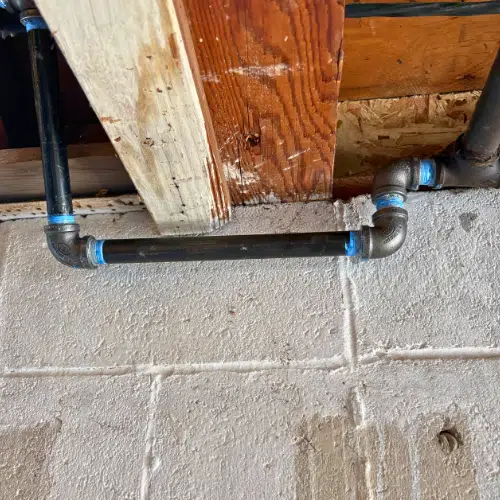
PHOTO 02 / ALONG THE ROUTE
The route is more than a distance.
- Floor framing. The wood structure affects where the route can pass and what can be reached.
- A change in direction. An elbow joins the pipe sections at a turn. Fittings belong in the route assessment as well as straight pipe.
- Another turn. The visible pipe continues downward.
Planning another outdoor connection?
Start with the appliance models and the route back to the meter. Our worked appliance-change example shows how to total the new demand. For generators, include the manufacturer’s location and exhaust clearances when choosing the outlet location.
Read the original Mountain Man project account and gallery ↗ACTUAL PROJECTS / LOCAL HOMES
See the work.
See what was involved.
Explore our recent gas-line and related plumbing jobs, with photos and a description of the work.
Recent and Related Plumbing Work


FROM OUR CUSTOMERS
Care you can
read about.
COMMON QUESTIONS / PLAIN ANSWERS
Before you book.
Open a question for details about the work, scheduling or an existing gas line.
Appliances, pipe and project options
What counts as gas line installation?
New appliance lines, extensions, relocated piping, added shutoffs and replacement of damaged pipe. We also repair customer-owned piping after a leak or utility shutoff. The quote lists the pipe work, connections, testing and permit or inspection arrangements.
Can you install a gas line for a new gas range or dryer?
Yes. Send the appliance model and location. We check the existing supply and plan the piping, shutoff and connector. If you are replacing an electric appliance, include its electrical and venting changes in the installation plan.
Can you install a gas line for a tankless water heater?
Yes. A tankless heater can use substantially more gas while running than the tank it replaces. We calculate the new demand on its branch and the shared piping back to the meter, then identify any piping or meter upgrades.
Can you run a gas line to an outdoor grill, fire pit or patio heater?
Yes. Send the appliance model and location, and tell us whether the route crosses a yard, deck or finished patio. Choose equipment made for the supplied fuel. A convertible propane appliance needs the manufacturer’s approved natural-gas conversion before use.
Can you install a gas line for a pool heater?
Yes. The heater’s fuel input, distance from the meter and other appliances sharing the route determine the supply needed. Send the model before installation so piping, pool work and any meter upgrade can be scheduled together.
Can you install a gas line for a whole-home or standby generator?
Yes, we handle the gas piping. Send the generator model and proposed location. Coordinate the pad, electrical connection and transfer switch—the device that switches the house between utility and generator power—with the other installers.
What size gas line do I need?
Pipe size depends on appliance demand, route length, material, available pressure and the appliances sharing each section. The fuel input shown on the appliance label gives its demand in BTU per hour. We use that rating and the full route back to the meter to size the piping.
What is the difference between black iron pipe and CSST?
Black iron is rigid steel gas pipe. CSST stands for corrugated stainless steel tubing; its ridges let it bend around framing, and it uses matching fittings. Modern black-jacketed, arc-resistant systems such as FlashShield+ provide added electrical protection without the manufacturer’s extra dedicated CSST bonding wire. They still follow standard gas-piping electrical bonding requirements. Product markings identify the system; a run containing conventional CSST still needs the extra bond.
What about flexible gas connectors at the appliance?
A short flexible connector joins an appliance to the nearby gas supply. Its listed capacity must cover the appliance’s demand, and its length and routing must fit the installation. The connector instructions also specify whether it can be reused.
Do you handle gas line work for home additions or remodels?
Yes. Kitchen moves, basement finishes and home additions can require new or relocated piping. Involve the plumber before framing is closed or cabinets are installed. We coordinate the agreed rough-in—the piping installed before finishes—with the contractor and other trades.
What about converting from propane to natural gas, or the reverse?
Check whether the appliance manufacturer offers a conversion for that model. Convertible equipment needs the specified parts and adjustments for the new fuel. We plan the gas piping and pressure around that fuel and coordinate the appliance conversion with the technician handling it.
Price, permits and preparing for the visit
Do I need a permit for gas line work?
New lines and changes to gas piping commonly require a permit and inspection. The building department serving the address identifies the permit needed. Your proposal should name who obtains it and schedules inspection.
Do you give pricing before starting gas line work?
Yes. We explain the work and price before starting. Route, access, appliance demand, permits and finish repairs affect the quote. Ask about any visit or diagnostic fee when scheduling.
Can I text photos before booking gas line work?
Yes, for planned work. Send a wide view of the appliance location, visible piping and the model label or specification sheet. Leave connected equipment in place. If you suspect a gas leak, leave and use the emergency numbers above.
How quickly can you come out for gas line work?
Tell us your target date and appliance delivery date when scheduling. We will discuss the next available visit and allow for permits, inspections and any utility work.
How long does gas line installation take?
An exposed route usually needs less access work than piping behind finished ceilings or under a patio. The schedule also includes appliance delivery, permits, inspection and any utility work. We discuss the installation date and the expected date the appliance will be ready to use.
What should I do before the plumber arrives?
Have the appliance model, proposed location, timing and any utility or inspection notice ready. Clear normal access to the work area while leaving connected equipment in place. The project checklist above helps organize these details.
Do you offer second opinions on gas line quotes?
Yes. Send the estimate and photos of the proposed route. We can compare the piping, appliance connections, testing, permits and finish repairs included in each price.
Are you licensed and insured in Utah?
Mountain Man Plumbing’s Utah plumbing contractor license is #12992295-5501. Verify the current license through Utah’s Division of Professional Licensing, and ask us for current insurance documentation.
What areas do you serve for gas line installation?
We are based in Sandy and serve the Salt Lake Valley, including Salt Lake City, Draper, South Jordan, West Jordan, Murray, Cottonwood Heights and surrounding communities. The local service links below give more detail. For mountain communities or an address near the edge of the service area, confirm coverage and scheduling with us.
What makes Mountain Man Plumbing different for gas line work?
We explain the appliance demand, pipe route and price before work starts. The project includes the agreed testing and inspection arrangements, followed by a walkthrough of the completed work and shutoffs. The project photos and customer feedback on this page show our work.
Existing lines and safety questions
I think I smell gas. What should I do?
Leave immediately and warn others to stay away. From a safe place, call 911 and Enbridge Gas Utah at 1-800-767-1689. Do not operate gas valves, switches, phones, vehicles or anything else that could create a flame or spark in the affected area. Follow emergency responders’ directions.
Can you do gas leak detection and repair?
Yes, we locate and repair problems in customer-owned gas piping after the immediate hazard has been handled. Send the utility or inspector’s notice if you have one. We identify the affected section, explain the repair and access needed, then test the repaired piping.
My gas company shut off my gas. Can you help get it back on?
We can assess the required repair, testing and permit or inspection work. Keep the utility’s notice so we can plan against its stated requirements. The utility and inspecting authority determine the clearance and restoration process. Do not remove a utility lock, open the meter or relight equipment yourself after a safety shutoff.
Why does my new gas appliance have a yellow flame?
Decorative gas appliances can be designed for yellow flames. New soot, a changed flame or poor operation needs a service check against the model’s expected performance. A technician uses combustion testing to assess how the fuel is burning. For a carbon-monoxide alarm, leave and call 911 from outside.
Can I install a gas line myself?
We recommend a qualified professional for gas piping. The work includes calculating pipe sizes, selecting compatible materials, protecting appliances during testing and completing permits and inspections. Gathering appliance details and choosing the proposed location are useful ways to prepare.
Utah Division of Professional Licensing ↗ · Local utility emergency guidance ↗
Our home base is Sandy. Tell us the project address when discussing the route, permit authority and scheduling.
Find your service area ↗The price, in plain terms
What does the
price cover?
- Name the work.What's being repaired or installed, and what stays.
- Check what's included.Parts, labor, access, cleanup and any required permit.
- Settle the open questions.Extra work, exclusions and the warranty for this job.
A quote for gas line work should make the scope clear. Check who handles access and patching, whether any further diagnosis costs extra, and what happens if opening things up reveals more damage.
Found a lower number? Ask us why ours is different. Bring both descriptions of the work. Compare the equipment, repair scope and exclusions before deciding what the difference buys. A higher price alone doesn't prove a better job.
- What gas line work costs in Utah What changes the cost and what to ask before agreeing. On Utah Plumbing Prices, which we publish.
- Already have a quote? Check it Use our second-opinion tool to work through the job and the price you've been given.
- How plumbing pricing works Flat rate, hourly, dispatch fees, permits: what each one means for what you pay.
From our local guides
Older homes. New plumbing projects.
Our county-record analysis shows when the neighborhoods were built. The repair guides explain the fixtures, pipes and remodel work.


