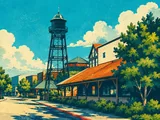
Highland, before the subdivisions
Apple trees.
Wells. Wooden pipes.
A few pages from Highland’s own historical collection. The water story is every bit as interesting as the orchards.
1919An orchard.
A 48-foot well.
William and Catherine Mower moved to Highland in 1919. Their 35-acre farm had peach and apple orchards, hay, grain and livestock.
The family history records a 48-foot well, dug with help from Mr. Turner of American Fork. The farm had its own water source years before Highland built a community drinking-water system.
The Mower family’s account ↗
Before 1946 · Dry CreekSpring meant
tightening the pipes.
The old canal crossed Dry Creek in two wooden pipes, each four feet across. In his Highland history, Charles Greenland remembers his father and water master Evar Strasburg tightening the U-bolts each spring: winter had dried the wood, and the pipes leaked when water returned.
Concrete replaced the wooden Dry Creek siphons in 1946.
4 ftEach wooden pipe’s diameter.
Water carried across the creek in a pair.
Read Greenland’s water history ↗
1958–1959Sixty households helped build the drinking-water system.+
Highland Water Company formed in February 1958. By that November, sixty people had joined and the well reached 600 feet. The original plans called for more than 11.5 miles of pipe and a 150,000-gallon reservoir. A December 1959 report recorded most members connected and using the water.
The company minutes and construction account ↗