
Water heater sizing
What size water heater will keep up with your house?
Tank gallons tell you how much is stored. Recovery tells you how fast the heater makes more.
Size for the busiest normal hour at your house.
Long story short
We help size water heaters around your household's hot-water use. Showers, tubs and appliances that run at the same time all matter. Compare tank capacity and recovery below, or tell us where your current heater falls short.
Jump to: Start with the busiest hour · What runs before the hot water turns cold · Capacity is only one part of fit · Why two 50-gallon heaters can perform differently
Skip the read? Book a visit or text (385) 766-8935.
The sizing rule
Start with the busiest hour.
Two back-to-back showers are different from two showers, laundry, and a dishwasher all at once. For a tank, we compare that busy hour with the first-hour rating. For tankless, we add the flow and Utah’s winter temperature rise. Copy the old size only if it already kept up.
Try your real routine
What runs before the hot water turns cold?
Your normal morning is a better sizing test than the number of bedrooms.
What runs at the same time?
A morning with two showers and a load of laundry tells us more than the total number of people in the house.
How does the old heater fall short?
Tell us when it runs out, how long recovery takes, and whether the problem has always been there.
What will fit the house?
Fuel capacity, venting, electrical service, condensate or drain access, clearances, and available space can rule options in or out.
Field note · Salt Lake City
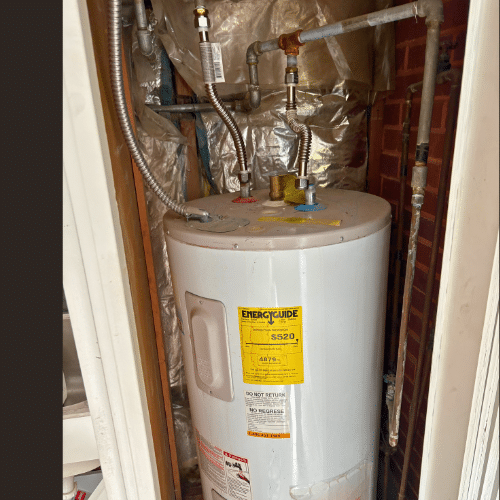
Capacity is only one part of fit.
This closet shows why room matters. Before choosing a replacement, measure the space, check the connections and leave room to service the heater.

The numbers that matter
Why two 50-gallon heaters can perform differently.
First-hour rating
This tested rating combines stored hot water and recovery. It is the useful quick comparison between storage heaters.
Recovery rate
Recovery is how quickly the heater replaces the hot water you used. Two same-size tanks can recover at very different rates.
Fixtures running together
Tankless sizing is based on the shower, tub, sink, dishwasher, and laundry that may overlap. Record which fixtures run together and their flow rates.
Temperature rise
Tankless flow ratings change with incoming-water temperature. The colder the incoming water, the fewer gallons per minute the heater can deliver at shower temperature.
Work through an example
Size the demand.
Then check the equipment.
Try a hot-water example
How much water needs heating?
A shower mixes hot water from the heater with cold water. Its total flow is different from the flow through the heater.
Try different numbers here to see how mixing works. Do not use the calculator to choose a hotter setting on your heater; that also changes the risk of scalding.
Water drawn from the heater
3.66 GPMAt an 80°F rise, about 81% of the mixed flow comes from the heater.
Orange: heated water · Blue: cold water mixed in
About 146,250 BTU/h must reach the water.
Navien lists 4.9 GPM at an 80°F rise for the NPE-240S2. This example uses less hot water than that published flow. Include all fixtures that run together when comparing a heater.
Show the calculation
Hot fraction = (105 − 40) ÷ (120 − 40) = 0.8125. Hot flow = 4.5 × 0.8125 = 3.66 GPM.
Heat delivered to the water ≈ 500 × hot GPM × temperature rise, in BTU/h. The 500 combines water’s approximate weight, heat capacity and minutes per hour. Fuel input also has to account for the heater’s efficiency, and distribution piping loses additional heat.
Worked example: two 2.0-GPM showers and a 0.5-GPM faucet, all mixed to 105°F. Measure your own fixtures and winter inlet temperature when planning a job. The model comparison appears only when your temperature rise matches a published point.
ENERGY STAR: mixing valves and stored hot water ↗Navien NPE-240S2: published flow table and dimensions ↗A trickle can be too little for tankless.
A tankless heater also needs enough water moving through it to start. Turning up its temperature makes a shower mix in more cold water, so less water passes through the heater. At a low draw, that can make heating stop. Check the model’s minimum starting flow before blaming a sensor.
A tank has a reserve and a refill rate.
Recovery is the speed at which the heater makes more hot water. First-hour rating combines a fully heated starting tank with heating during the test. Compare published ratings under the same test conditions.
For this example, imagine two 50-gallon tanks with first-hour ratings of 65 and 85 gallons. The second supplies 20 more gallons during that hour. The rating accounts for how the stored supply is used and how much water is reheated. A large tub filled all at once also needs enough stored hot water to cover that initial draw.
Technician reasoning: distinguish lost capacity from undersizing
Record outlet temperature, draw rate and recovery with the equipment fully heated, using its manufacturer’s draw-test procedure. A unit that used to handle the same routine may have lost output. A new demand pattern can exceed a healthy unit. Compare those possibilities before specifying extra capacity.
Where these explanations come from
Read the manufacturer and technical references behind this lesson. For service settings, open the manual for your full model number.
Recent work, real homes
See this work in the field.
Open a job to see the equipment, the problem, and the finished work.

North Salt Lake Bradford White Water Heater Swap
Open the job →
Downtown Condo Bradford White Swap and Floor Drain Clear
Open the job →Common questions
The questions that keep the next shower hot.
How many gallons does my family need?
Gallons alone cannot answer it. We compare the busiest hour with the heater’s first-hour rating and recovery, then make sure the equipment fits the house.
Is a larger tank always better?
No. A larger tank takes more room and may still recover slowly. Sometimes a better-performing tank of the same size is the smarter fix.
How is tankless sizing different?
We add the fixtures that may run together and calculate how much the heater must warm the incoming water. Both numbers change the answer.
Tired of the cold finish?
Size the new heater around your real routine.
Tell us what runs together and when the old heater falls short. We’ll check the demand and the room before recommending equipment.


