
Repair or replacement
Repair it or replace it? Start with what failed.
Assess the tank, the failed component and the value of the repair.
If the steel tank leaks, replace the heater. If the tank is dry, identify and price the failed part first.
Long story short
We help you decide whether to repair your water heater or replace it. You'll need to know what's failed, what the repair costs and what a complete replacement would include. We'll talk through those options for the heater you actually have.
Jump to: Is the steel tank leaking · Repair it, replace it, or check it first · What changes the value of a repair · Look at the condition behind the repair decision
Skip the read? Book a visit or text (385) 766-8935.
The rule that matters
Is the steel tank leaking?
A leak through the steel tank requires heater replacement. With a sound tank, price the failed component’s repair and compare it with the remaining warranty, service history, hot-water performance and availability of parts.
Three honest outcomes
Repair it, replace it, or check it first.
The tank is dry and one part failed.
A sound tank keeps repair on the table. Price the failed element, control, valve, connector, or other part.
Water is coming through the tank.
A leak through the inner steel tank calls for replacement. To locate it, trace water on the cover or floor back to the first wet point.
The failure is still unclear.
Mystery water and intermittent faults need a diagnosis before a repair or replacement price means anything.
The repair decision
What changes the value of a repair.
The inner storage tank
A sound pressure vessel keeps component repair possible. A leak confirmed through that vessel calls for replacement. Check the upper connections and valves when tracing exterior moisture.
The failed part
Ask which part failed, how it was checked and what replacing it will restore. The estimate should include the part, labor and testing after the repair.
Age, warranty, and parts
The serial number can tell us when it was made once we match the brand’s date-code format. We also check warranty coverage and whether the right part is still available.
Recent repair history
One isolated repair is different from repeated trouble or the same fault returning within the last couple of years.
Hot-water performance
If a healthy heater never kept up with your routine, copying its size may repeat the problem. If it used to keep up, find out what changed first.
What is around the heater
Venting, pressure, thermal expansion, restraint, drainage, and clearances can add work or rule out a replacement option.
Field note · Salt Lake City
Look at the condition behind the repair decision.
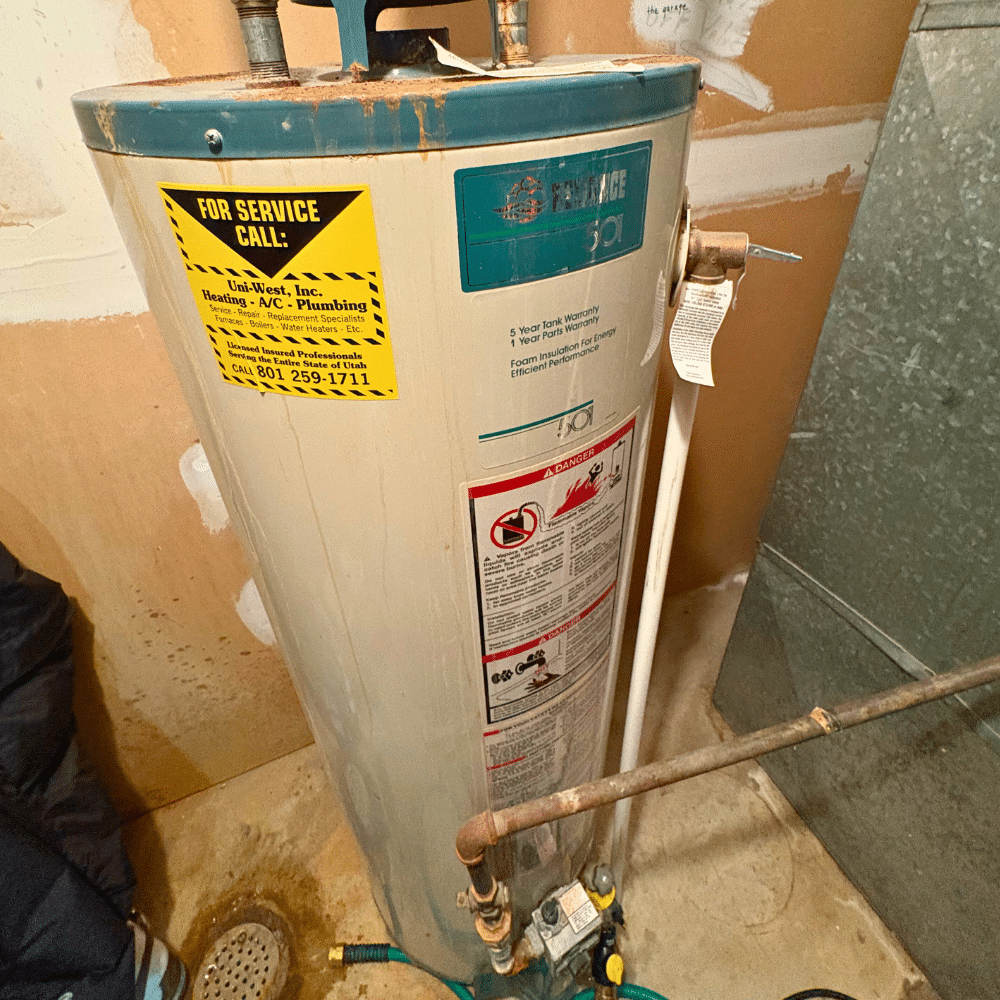
Corrosion and worn connections affect the work needed around the heater. A useful recommendation identifies the leak or failed component, then weighs that repair against the condition of the rest of the unit.
Compare the money
Three questions make the recommendation clear.
A useful estimate should answer these in plain English.
What exactly failed?
Ask the plumber to name the failed part and explain the test or visible damage behind the recommendation.
Why is repair or replacement better?
The plumber should point to the leak, failed test, repair history, or installation condition that changes the choice.
What will the new heater improve?
If replacement is recommended, ask whether it fixes capacity, recovery, venting, or another problem you already had.
A decision you can follow
Compare two complete jobs.
Start with the failed part and the condition of the tank. Then compare repair cost, parts availability, warranty and whether the heater meets the household’s hot-water needs.
| Evidence | What it changes | What to ask for |
|---|---|---|
| Leak proven through the storage tank | Replacing a control cannot repair the vessel. | The confirmed source and location of the leak. |
| Dry tank; isolated replaceable component failed | A repair may restore normal performance. | Which component failed, how it was tested and the price to repair it. |
| Multiple failures or unavailable parts | Downtime and additional repairs affect the value. | Documented repair history and actual parts availability. |
| Healthy heater cannot meet current demand | A like-for-like replacement may repeat the complaint. | A demand and recovery comparison. |
| Installation is contributing to the failure | The surrounding problem must be addressed. | How pressure, venting, power or water quality will be corrected. |
In this price exercise, an $800 component repair costs $2,000 less today than a $2,800 replacement. If the tank is sound and meets the household’s needs, that repair may be worthwhile. A corroded tank, repeated failures or hard-to-find parts can make replacement the better use of the money. Compare the complete work and warranty for both options.
Put the warranty in writing.
Ask what coverage applies to the tank, replacement parts and labor, and what charges remain. Keep the warranty terms with the model, serial number and installation invoice.
Navien NPE-2 owner’s manual: maintenance and troubleshooting ↗Where these explanations come from
Read the manufacturer and technical references behind this lesson. For service settings, open the manual for your full model number.
Recent work, real homes
See this work in the field.
Open a job to see the equipment, the problem, and the finished work.

North Salt Lake Bradford White Water Heater Swap
Open the job →
Downtown Condo Bradford White Swap and Floor Drain Clear
Open the job →Common questions
What to ask before you spend money either way.
Is an old water heater automatically a replacement?
We diagnose the failure and verify the age. Then we compare the repair cost, tank condition and warranty to explain the options.
Can the steel tank itself be repaired?
No dependable field repair exists for a leaking steel tank. Parts attached to a sound tank may still be repairable.
Why talk about size during a replacement?
Replacement is a chance to improve hot-water delivery. Compare the household’s busy period with the new heater’s first-hour rating or tankless flow rating.
Repair or replace?
See the reason before you choose.
If a repair makes sense, you’ll get a repair price. If the tank failed, we’ll show you the leak and size the replacement for the house.


