
No hot water
No hot water? Follow the heating process.
Gas, electric, tankless, and boiler-fed heaters make hot water in different ways. The first checks are different too.
Tell us whether every hot tap is cold and when the problem started. The technician compares water leaving the heater with water arriving at the fixtures to locate the failure.
Long story short
No hot water? We troubleshoot gas and electric water heaters and repair the problem. Tell us whether the whole house has gone cold or just one fixture. A photo of the heater's label helps us identify the equipment before the visit.
Jump to: Is it always cold, or does it turn cold later · What kind of heater is in the house · Recognize the gas-heating components · What the hot water does points us in the right direction
Skip the read? Book a visit or text (385) 766-8935.
The fastest way to narrow it down
Is it always cold, or does it turn cold later?
That answer narrows the problem fast. Next, identify the heater. The vent, access panels, gas control, or display will show whether we should follow a gas, electric, tankless, boiler, or fixture problem.
Pick your heater
What kind of heater is in the house?
Gas tank
Look for the gas pipe and burner control. Some gas tanks use a fan and plastic venting; others use a metal vent. Photograph the label and full blink pattern so we can match the model.
Electric tank
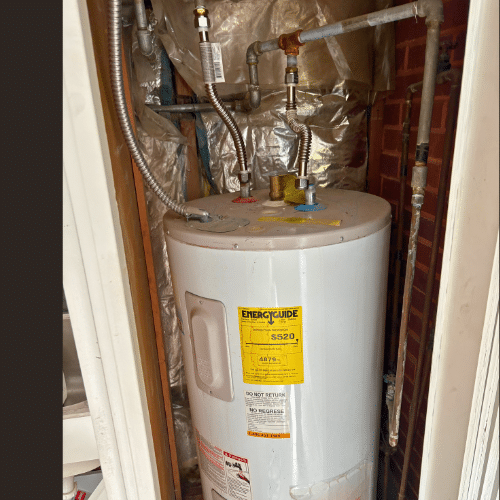
Many have two rectangular access panels and no exhaust vent. Tell us whether the water is completely cold or gets warm for a few minutes first.
Tankless
Write down the brand, complete model number, and exact code on the display. The model keeps us from reading the wrong manual.
A tank connected to the boiler
These use heat from the boiler. The trouble may be in the tank, pump, zone control, or boiler instead of a water-heater burner.
Field note · West Valley City
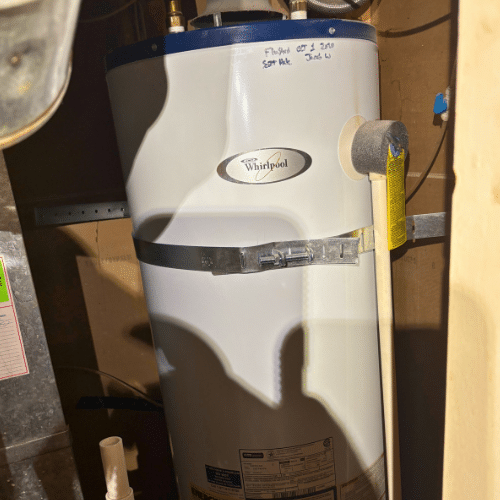
Recognize the gas-heating components.
The gas control near the bottom regulates fuel to the burner beneath the tank. Heat travels up through the central flue, and the metal vent carries exhaust outdoors. The technician follows that fuel, ignition and exhaust path when diagnosing a heating failure.
Read the pattern
What the hot water does points us in the right direction.
You do not need to guess the failed part. Notice when the water turns cold and whether every fixture does the same thing.
Every faucet stays cold
The heater may have stopped heating. But a mixing valve can also send cold water through the hot pipes, or a hidden hot-water leak can use up the supply. We check whether hot water is leaving the heater before blaming a part.
Hot water fades too soon
The stored hot water may be running out faster than the heater can warm its replacement. An electric tank with a failed lower element heats less of its volume. A broken dip tube—the tube carrying incoming cold water to the bottom—can let cold water mix near the hot outlet.
Only one fixture is cold
That points away from the heater and toward the faucet, shower valve, or nearby piping.
The diagnostic path
Follow hot water from the heater to the tap.
If water leaves the heater hot but arrives at one shower too cool, check the path between them. The shower’s mixing valve blends hot and cold water, so a fault there can affect that shower while other taps work normally.
| What you notice | What it suggests | What separates the possibilities |
|---|---|---|
| One shower stays cool; other hot taps work | A fixture control or mixing problem is more likely than complete heater failure. | Compare temperatures at several fixtures; assess the affected valve. |
| Every fixture is cold | The heat source, controls, or a system-wide mixing problem needs investigation. | Compare heater outlet temperature with fixture temperature before selecting a part. |
| An electric tank provides a little hot water, then cools | The upper portion may be heating while the lower portion is not. Demand or mixing can also explain it. | The technician tests power, thermostats and both heating elements to find which part of the heating sequence has stopped. |
| A tankless unit starts, then stops | The point in the sequence where it stops matters. | Record flow, code and operating state; compare with the exact model’s procedure. |
| A boiler-fed tank is cold | The tank depends on a separate boiler and heat-delivery circuit. | Check whether the control requests heat and whether that heat reaches the tank coil. |
Technician reasoning: why the lower element can shorten a shower
Many electric tanks have two elements that heat one at a time. The upper thermostat heats the top of the tank first, then hands control to the lower thermostat. If the lower circuit fails, the upper portion can still provide a short hot-water supply. The model’s wiring diagram shows how its thermostats and safety controls connect.
The technician tests the power supply, thermostats and elements to locate the failure. Electrical resistance and insulation tests are made with the circuit safely isolated.
What a plumbing crossover means
An unintended connection lets cold water enter the hot-water piping. A defective mixing valve can cause this without an external leak. A technician isolates sections to locate the path and checks that the isolation valve actually closes; otherwise the test can mislead.
Rheem: plumbing crossover ↗Where these explanations come from
Read the manufacturer and technical references behind this lesson. For service settings, open the manual for your full model number.
Recent work, real homes
See this work in the field.
Open a job to see the equipment, the problem, and the finished work.

North Salt Lake Bradford White Water Heater Swap
Open the job →
Downtown Condo Bradford White Swap and Floor Drain Clear
Open the job →Common questions
The questions we ask when the water stays cold.
Should I reset the water heater?
Photograph the code first. Reset only if your model’s user manual says to for that problem. If the fault comes back, stop resetting and have the cause checked.
Does no hot water mean I need a new heater?
No. Heating elements, thermostats, ignition parts, controls, and wiring can often be repaired. A leaking tank is a different story.
What pictures should I send?
Send the whole heater, the manufacturer label, and the control or display. Those three photos answer most of our first questions.
Ready to get the hot water back?
We can take it from here.
Send one wide photo, the control or display, and whether the water stays cold or turns cold later. The plumber will see it before the visit.


