The wash cycle ends, the pump kicks in, and water climbs up the standpipe and spills onto the floor. A minute later it's gone and the pipe looks completely normal. Every other drain in the house works fine.
A washing machine puts more water into a drain, faster, than anything else in the house, and a drain that handles every other fixture without complaint can still be unable to swallow it.
Right now: stop the machine and don't start another load. The water stops when the pump does. If there's water on the floor around it, shut that circuit off at the breaker rather than reaching behind a wet appliance for the plug. If what came up is sewage rather than wash water, or the machine sits above finished space, treat it as urgent and read the last section first.
What it actually does
Of 228 who described the symptom. Some had more than one.
Start with that last one, because it sends you somewhere else entirely. If the drum stays full and the standpipe is bone dry, no water ever reached the drain. That's the machine's pump or its pump filter, and it's an appliance repair. Everything below is about water that left the machine and then had nowhere to go.
Before you snake anything: is it blocked, or can it not breathe?
A washing machine doesn't empty by gravity, it pumps. GE rates its top-load pumps at 15 to 17 gallons a minute, and Whirlpool and Maytag ask for a 2-inch standpipe that can carry away 17. So the question is never really whether the drain is clogged. It's whether it can take that rate for as long as the pump runs, and a pipe can be completely open and still fail that.
There are two failure modes, they need opposite repairs, and a bucket tells them apart in about ten minutes.
- Pull the machine's drain hose out of the standpipe and put it in a laundry sink or a bucket so it can't spill.
- Fill a 5-gallon bucket and pour the whole thing down the standpipe as fast as it will go.
- Watch the pipe, not the floor. You want to know whether the water level rises and stalls, or just disappears.
If the water backs up in the standpipe on a bucket, you have a restriction. Something is physically in the way and the pipe needs clearing.
If the bucket vanishes without the level rising, the pipe is open. Now run the machine and listen, because a drain that passes a bucket and still overflows on the pump-out is not blocked — it can't get air.
A bucket is a rate test, not a volume test. Dumping 5 gallons is a hard shove for a couple of seconds; the pump pushes that rate continuously for a minute or more. Passing the bucket test means the line isn't plugged. It does not prove the line is clean.
Two more checks, both free, and both done while the machine is actually pumping:
- Go listen at the nearest toilet and tub. Gurgling, bubbling or the toilet water visibly moving while the washer drains means the drain is pulling air through another fixture's trap because it can't get it from a vent.
- Come back a day later and smell the laundry room. A sewer smell that shows up after laundry day and fades in between means the washer's trap is being siphoned empty. An empty trap is an open pipe to the sewer.
What was actually wrong
Of 216 where a cause was identified. More than one often applies, so these add to more than 100%.
The first line on that chart is why the bucket test comes before the snake. Snaking a drain that was never blocked is a common and expensive way to learn nothing.
When it's the vent.
Water going down a pipe has to be replaced by air coming the other way, or it can't go. That's what a vent is for. Turn a full gallon jug upside down and watch it glug instead of pour — that's a drain with no vent.
At a trickle it doesn't matter. At 17 gallons a minute it decides everything. An unvented or badly vented drain does one of two things under that load: the flow chokes and the water stacks up the standpipe until it comes out the top, or the moving water finds air by yanking it through the nearest trap, which empties that trap and lets sewer gas into the house. Plenty of houses do both.
The code that governs this is a distance, and it is shorter than people expect. The run from the trap to the point where the vent connects is the trap arm, and the maximum developed length is fixed by pipe size: 6 feet on a 1½-inch arm, 8 feet on a 2-inch arm.
Those aren't arbitrary. The rule behind them is that the trap arm may not fall more than one pipe diameter over its whole length. A 2-inch pipe at the code slope of ¼ inch per foot drops exactly 2 inches in 8 feet, and that is where the number comes from. Fall further than that and the arm runs full instead of half full, the full bore acts as a siphon, and it pulls the trap seal out behind it.
This is why sloping a drain more can break it. At ⅜ inch per foot, a 2-inch trap arm hits its one-diameter limit at 5 feet 4 inches, not 8 feet. A helpful extra pitch on a laundry line is a real and fairly common cause of a trap that keeps siphoning dry.
Two placement rules go with the distance, and both get missed:
- The vent connection cannot be below the trap weir. If it is, waste runs into the vent instead of air running out of it.
- It cannot be closer than two pipe diameters to the weir — 4 inches on a 2-inch arm. Any nearer and the connection sits in the part of the arm that runs full, so it never draws air.
In practice the vent problems that show up in a laundry are: a washer added to a line that never had a vent, usually a bathroom sink line someone teed into; a vent stack blocked by a nest or ice; or a machine swapped for a modern one on plumbing that was marginal all along and only failed when the flow rate went up.
Air admittance valves, and what they can't do
Where there is no practical way to run a real vent, an air admittance valve is the usual answer. It's a one-way valve that lets air in when the drain pulls a vacuum and seals shut the rest of the time. For a single fixture you want one listed to ASSE 1051, and the install rules are specific:
- At least 4 inches above the horizontal drain it's venting.
- Accessible. It's a mechanical part and it wears out. Behind sealed drywall is not acceptable.
- In a space that can actually get air to it, so not sealed inside a wall cavity or buried in insulation.
- Venting only fixtures on the same floor, connected to a horizontal branch drain.
- The house still needs at least one vent running to open air outside. These supplement a vent system; they don't replace one.
An AAV that has failed shut behaves exactly like no vent at all, which makes it worth checking first if one is already installed. Not every jurisdiction accepts them, so confirm locally before you rely on one.

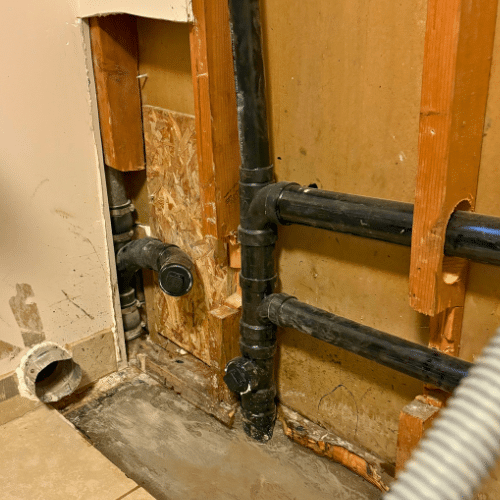
When it's a clog, it's lint.
A washing machine sheds an enormous amount of lint, and it goes down the drain with warm soap and whatever else is on the clothes. It builds up on the pipe wall, the bore narrows, and one day the flow rate the machine needs is more than the flow rate the pipe still has.
The signature is that it gets worse over time. It starts as an occasional overflow on the biggest load, then most loads, then every load. People usually notice they've been quietly working around it — running smaller loads, skipping the heavy cycle — before they notice it's a fault. A vent problem doesn't behave that way. It's there from the day something changed and it's there on every load.
A restricted laundry line needs a drain cable, not a chemical. Run it from the standpipe or from a cleanout on that branch, with the biggest cable and head that will fit the pipe, because the goal is to scrape the wall clean rather than poke a hole through the middle of a grease plug. The hole closes again in a month; a cleaned pipe doesn't.
Do not put a mesh lint sock down inside the standpipe. It is a popular fix and it fails the same way every time: at pump-out flow the water either pushes the trap back out of the pipe or backs up around it, so you've added a restriction to a drain that already couldn't keep up. If you want to catch lint, catch it on the end of the discharge hose where you can see it and clean it, and clean it often.
One more thing worth checking while you're in there: drain pipe must never get smaller as it goes downstream. A 2-inch laundry line reduced to 1½ inches at a tee is a permanent restriction that no amount of snaking will fix, and it's a common find in a basement where someone added a laundry to existing plumbing.
Measure the standpipe.
If the pipe is open and vented and it still overflows, the geometry is wrong. All of this is measurable with a tape in five minutes.
| What to measure | What it should be | What goes wrong |
|---|---|---|
| Standpipe and trap size | 2 inches, connecting to a 3-inch or larger branch | 1½-inch pipe is everywhere in older homes and is below the code minimum for a washer |
| Height above the trap weir | 18 to 42 inches under the IPC; 18 to 30 under the UPC | Too short and the machine siphons itself. The upper figure is a code limit, not the pump's reach — that's the 96-inch row below |
| Trap height above the floor | 6 to 18 inches, and never below the floor | A trap under the slab can't be rodded and the long drop above it siphons |
| Top of standpipe above the washer base | At least 30 inches, no more than 96 | Above 8 feet the pump cannot empty the tub at all |
| Trap arm to the vent | 8 feet maximum on 2-inch at ¼ inch per foot | Over the distance, or over-sloped, and the trap siphons dry |
Two of those need explaining because they're the ones that produce weird symptoms rather than an overflow.
A standpipe that's too short siphons the machine. Once the water in the drain forms a continuous column below the level of water in the tub, it keeps pulling after the pump stops. The machine fills and drains at the same time, never reaches level, and runs a cycle that never ends. Top-loaders ship with a plastic anti-siphon clip for exactly this, to hold the hose up at the back of the machine when the drain is lower than 30 inches. It's usually still in the bag of parts in the drum.
An S-trap siphons every time. If the pipe leaves the trap and turns straight back down, rather than running horizontally to a vent, the falling water pulls the seal out behind it. It'll drain fast and smell within a day or two. That's a re-pipe, not an adjustment, but knowing which one you have tells you why the smell keeps coming back.
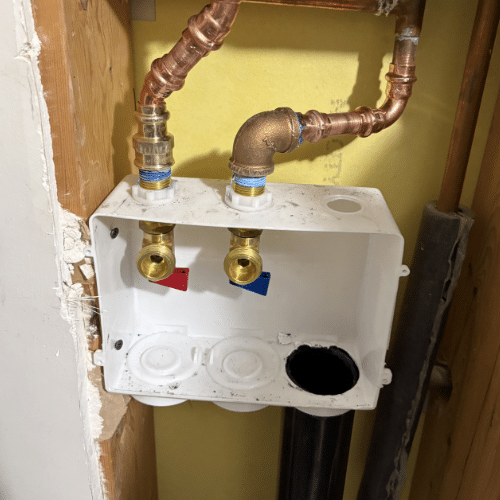
The standpipe also has to be individually trapped, with access for rodding. If your washer and your laundry sink share one trap, or you find two traps in series on the same line, that's the fault.
How far the hose goes in, and why it must not be sealed.
The drain hose is supposed to hang loose in the standpipe with an air gap around it. The code calls this an air break, and it's required, but the practical reason is the one that matters: a sealed hose turns the machine, the hose and the drain into one continuous tube, and a continuous tube siphons.
Manufacturers give a depth. Maytag says no more than 4½ inches of hose inside the standpipe and to secure it with a cable tie. GE allows 5 inches on a top-loader and 7 on a front-loader. Nobody allows what people actually do, which is push it down until it stops.
Securing it and sealing it are different jobs. A cable tie keeps the hose from jumping out of the pipe when the pump surges, which it will. Tape, a rag packed around the hose, or a rubber boot forced over it closes the air gap, and that gives you three new problems: the siphon, no way for the standpipe to breathe, and a backup that now flows into the machine instead of onto the floor where you'd see it.
If water is getting into the machine when it shouldn't, or the machine won't stop filling, check this before anything else. It's the cheapest fix on the page.
When other fixtures are involved, stop.
Everything above assumes the laundry is the only thing misbehaving. Once other fixtures join in, the problem moved downstream and it's a different job.
Laundry water appearing in a tub or a shower, a toilet that rises and falls when the washer pumps, or more than one fixture backing up means the blockage is in shared pipe downstream — the main line, most likely. Snaking the laundry branch will not reach it, and running the machine again to test just puts more water on the floor. If what comes up is sewage rather than wash water, that's the main line, and it needs clearing before anyone uses any fixture in the house.
A bang or hammer noise when the machine fills is unrelated to all of this. That's on the supply side and it's a pressure and water hammer problem, not a drain one.
When it's a call, not a repair.
- The trap is under the slab or otherwise not reachable.
- There is no vent and one has to be added. That's pipe inside a wall, and it's permit and inspection work in most places.
- You've snaked it and it came back within a couple of months. Repeat clogs in the same spot usually mean the pipe is undersized, bellied or broken, and a camera will find in twenty minutes what guessing won't find at all.
- The laundry line is 1½-inch and the machine is new. That's a re-pipe of the branch, and it's the actual fix rather than a yearly snaking.
- Sewage, or more than one fixture backing up.
If the machine is on a second floor, treat an overflow as urgent regardless of cause. The water goes into the ceiling below and you will be paying a drywall bill on top of a plumbing one.
Symptom and cause percentages come from 389 washing machine drain problems posted to the Terry Love and plbg.com plumbing forums, limited to people reporting an actual fault rather than planning an installation, and read for what each one turned out to be. Code requirements cited are IPC 406.2 and 802.4.3 (standpipe size, trapping and height), IPC Table 909.1 and IRC Table P3105.1 (trap arm length), UPC 804.1 (trap height above floor) and IPC 918 / IRC P3114 (air admittance valves); your jurisdiction's adopted code governs. Flow rates and hose depths are from GE, Whirlpool and Maytag installation documentation, linked above.