Water is coming out of the outside faucet and you are about to go buy a washer. Hold off ten minutes, because "the hose bib leaks" covers several separate faults and the three big ones are nothing alike. One is a ten dollar part that unscrews off the end of the spout. One is a nut you tighten with a wrench you already own. And one means the faucet is done and the damage happened last winter.
Which one you have is decided entirely by where the water appears, so go look before you buy anything.
Right now: if water appears inside the wall or in the basement while the faucet is open, shut the water to that line and leave the faucet alone. Everything else here can wait until you have looked at where the water is coming from.
Where people found the water coming from
Of 146 homeowners who said where the leak was. Some had more than one.
Notice what is not at the top of that list. Almost everybody assumes a leaking outdoor faucet means a worn washer dripping out of the spout, and that turns out to be the rarest thing on the list.
First, you almost certainly have a frost-free.
What's actually on the wall
Of 163 who described their hardware.
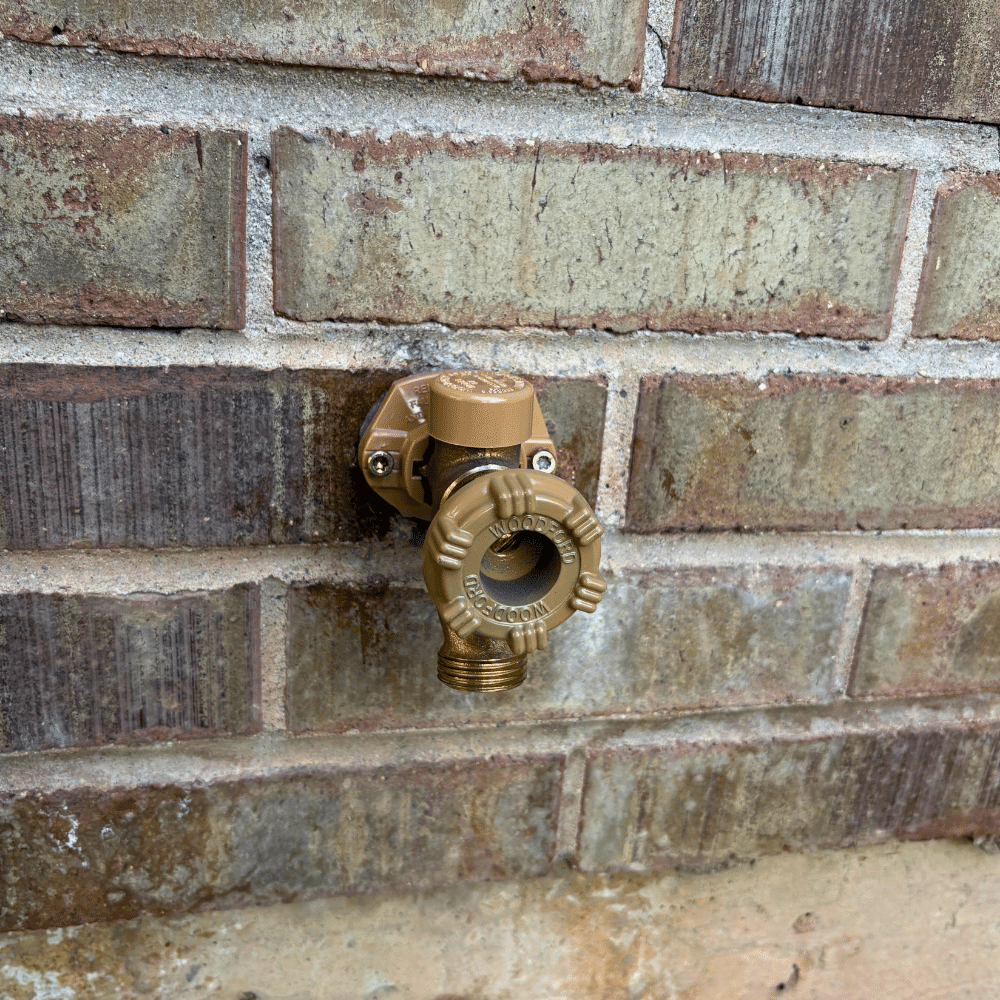
This matters more than anything else in this guide. On a plain old hose bib, the valve is right there behind the handle. On a frost-free, the valve is six to fourteen inches back inside your warm wall, and the handle turns a long rod that reaches it. The thing sticking out of your siding is mostly just a tube.
How to tell without tools: a frost-free has a noticeably long body and the handle takes several turns to shut. If yours was installed any time in the last thirty years in a cold climate, it is one.
Everything below depends on knowing this, because it means the water you see outside may have traveled there from somewhere you cannot see.

Dripping from the cap on top: the common one, and the cheap one.
That small cap or dome above the spout is the vacuum breaker — a backflow device that stops hose water being siphoned back into your drinking water if the pressure drops. It is required on outdoor faucets, and it is a wear part.
When it fails it dribbles or sprays out of the top, usually while the water is running, and people understandably assume the whole faucet is shot. It isn't. The vacuum breaker is sold as its own small kit — a cap, a poppet and a washer — and replacing it does not involve touching the valve, the wall, or the water supply beyond shutting it off.
This was the single most reported symptom in the whole set, and it's the least serious. Check it first.
Water around the handle while it's running: usually just a nut.
If the faucet is dry when off but weeps around the stem the moment you turn it on, that is the packing, and it is frequently a no-parts fix.
Woodford's own troubleshooting for their Model 14 says to tighten the packing nut behind the handle until snug and the leak stops, without removing anything. Only if it keeps weeping do you need a new packing ring.
One warning that has caught a lot of people out, and it applies to the Mansfield-style hydrants that dominate this corpus: the packing nut may be left-hand threaded. A left-hand nut is marked with an L or with arrows, and it comes loose by turning it to the right. If a packing nut won't budge, check the marking before you lean on it harder and snap something.
Water inside the wall: stop, and don't turn it on again.
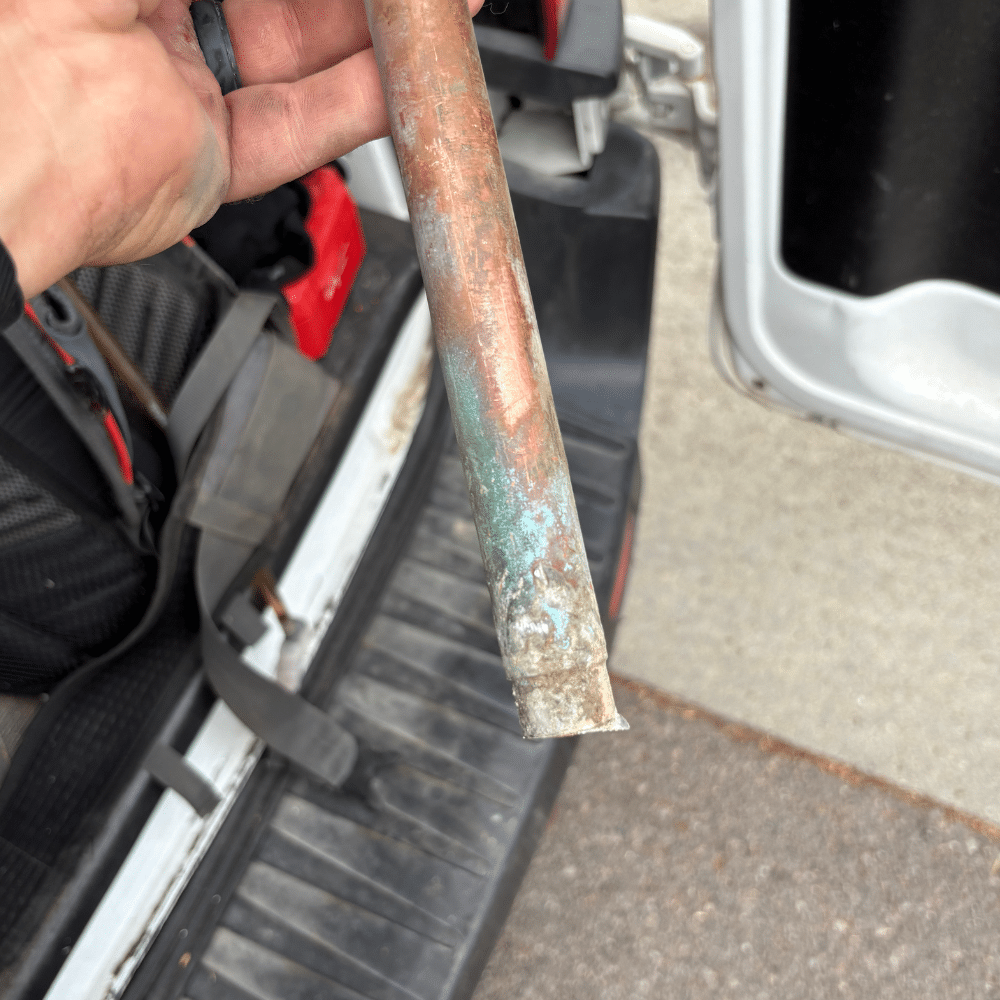
If the outside stays dry but you get water in the basement, the crawl space, or down the inside of the wall only when the faucet is open, then the tube split, and it split from freezing.
Woodford is blunt about this one. Their troubleshooting sheet for the same faucet says plainly: replacement of the faucet is required. There is no seal kit for a burst tube.
The part worth understanding is why you are only finding out now, and it's the best argument in this whole guide for going outside tonight:
The split happens in the depths of winter, but the burst is on the downstream side of a closed valve. So at the moment it bursts, only a few drops escape and nothing at all shows up inside the house. It stays invisible until somebody opens the faucet months later to wash a car or fill a kiddie pool — and then it runs, at full pressure, inside the wall. Woodford's own words: "there can be a considerable amount of time between the actual rupture of the tubing and the discovery of the problem."
That is why this failure shows up as a flooded basement in May caused by a cold snap in January. If you suspect it, shut the water to that line and leave the faucet alone.
Dripping from the spout when it's off, or a handle that spins.
These two are the rarest on the chart but they're the ones that send you inside the faucet, so they belong together.
Dripping from the nozzle with the handle closed means the rubber washer on the far end of the operating rod is worn — or, and check this first because it's free, the little screw holding that washer on has worked loose. Woodford list both causes for the same symptom. On a frost-free that washer is a foot back inside the wall, which is why this job means pulling the whole rod out rather than undoing something behind the handle.
A handle that keeps turning and never shuts the water off is a different fault with a worse answer. Woodford's diagnosis is that the retainer has come off the end of the operating rod, and the fix is a new rod — the old one can't be repaired. Pull it out and you'll see it straight away: the end that should carry a washer will be bare.
If the handle turns and nothing changes at all, check the shutoff first. Somebody may have closed the valve that feeds the line, and a working faucet on a dead line behaves exactly like a broken one.
Pulling the stem out, which is most of the repair.
On a frost-free, the packing, the washer and the rod all come out as one piece, so this single procedure covers every repair except the vacuum breaker and a split tube. Woodford's sequence for the Model 14 is the one below, and most other brands work the same way.
- Shut off the water to that line and open the faucet to drain what's in the tube. On a frost-free the tube holds most of a cup and it will run out of the nozzle onto your shoes.
- Take the handle off — one screw through the middle.
- Back the packing nut out. This is the hex nut immediately behind where the handle sat. Remember the left-hand thread warning above if it won't budge.
- Put the handle back on loosely and turn the rod counter-clockwise until it unscrews from the valve seat and goes slack. You're using the handle as a tool here, not opening the faucet.
- Pry the packing loose with a small screwdriver so it isn't gripping the rod.
- Pull the rod straight out. Woodford's note is worth having in advance: many rods carry a check valve part way along that grabs on the way past, so it needs a swift pull rather than a steady one. It is not stuck.
- Replace what's worn — seat washer and its retainer screw at the far end, packing ring at the near end — and reverse the whole thing. Snug the packing nut, then test at pressure before you put the handle back for good.
If you fit a new washer and it still won't shut off, stop. Woodford's line is that the seat inside the valve body is damaged and the faucet needs replacing. That seat is not a serviceable part on a residential sillcock.
Why it froze, and the five minutes that prevent it.
What people said caused it
Of 139 who named a cause.
A frost-free only works because of one thing: when you shut it off, the water left in that long tube drains out through the spout. The valve is indoors in the warm, the tube empties itself, and there is nothing left to freeze.
Attach a hose and you have plugged the drain. The tube can't empty, the trapped water freezes, it expands, and since the valve is shut there is nowhere for that pressure to go except through the copper. Woodford says it flat out: the only possible cause of a burst tube is an obstruction that prevents the faucet draining, or bad installation.
And it is not only garden hoses. Their sheet specifically names add-on vacuum breakers and some quick-connect adapters left screwed on the nozzle. Those brass snap fittings people leave on all year round will hold water in the tube exactly like a hose will.
So before the first hard freeze, walk around the house and take everything off every outdoor spout — hoses, splitters, quick-connects, screw-on breakers, timers. Leave the nozzle bare and the handle closed.
Along the Wasatch Front, your deadline is about October 20. That's the 1991–2020 average date of Salt Lake City's first 32°F freeze. It's an average, so some years it arrives two weeks sooner. Do it in September and you can forget about it.
Two other things stop a frost-free draining, and they're worth checking while you're out there: the spout has to point downward, and the tube has to run slightly downhill towards it. If yours points up or sits dead level, it will not drain no matter how diligent you are about hoses, and it will eventually split.
Getting the right parts.
Brand mentions in the source threads were dominated by two names — Mansfield at 48% and Woodford at 31%, with Arrowhead and Prier behind them. Take the old part with you, or at minimum a photo of the faucet with the handle off.
Woodford publish their Model 14 parts list, which is a useful map even if yours is another brand, because every frost-free has these same five pieces:
| Symptom | Part that fails | Woodford part no. |
|---|---|---|
| Weeps around the stem when running | EPDM packing ring | 30560 (plus support washer 30006) |
| Drips from the nozzle when off | Valve seat rubber, or its retainer screw | 30008 and 30009 |
| Handle turns forever, never shuts off | The whole operating rod | 35-series, sized by length |
| Doing all of the above at once | Repair kit — handle, nut, packing, washer, screw | RK-14MH |
If yours is a Mansfield-style wall hydrant, the equivalent kits are 630-7755 for the stem and 630-8500 for a complete overhaul including the handle and vacuum breaker. Two cautions there. Those kits are documented as covering the 300, 400 and older 500 series, so check your series rather than assuming; other series may need a different stem or a whole new faucet. And these kits deliberately contain parts for several models at once, so having pieces left over at the end is normal and not a sign you've done it wrong.
Whatever the brand, length matters as much as model — a stem for a 6" hydrant will not fit a 10" one. Measure the rod you pulled out, or take it with you.
When it's a call, not a repair.
- Water appears inside the wall, ceiling or basement when the faucet runs. The tube is split and it needs replacing.
- You can't find a shutoff for that line, or the shutoff won't fully close.
- The faucet turns in the wall, or the whole body moves when you use the handle.
- It's soldered copper and you're not comfortable with a torch inside a wall cavity.
- You've rebuilt the stem and it still won't shut off — the seat itself is damaged.
- There's no vacuum breaker on the faucet at all. That's a backflow issue on your drinking water, not just a leak.
Hose bib and outdoor faucet repair ↗ · Find your main shutoff ↗
Where the numbers come from: 403 homeowner questions about outdoor faucets, hose bibs and sillcocks posted to public plumbing forums, scoped to threads about a faucet that was leaking or failing rather than new installs or irrigation, and sorted by what each person described. Because they count what people wrote down, each figure is a floor. Technical sources: Woodford Manufacturing's "How a Standard Frost-Proof Faucet Works", their Model 14 troubleshooting sheets and Model 14 catalog parts list for the operating rod removal sequence and part numbers, and the Model 14/17 installation instructions; Prier/Mansfield wall hydrant service documentation for the repair kit coverage and the left-hand thread packing nut. Freeze date is the 1991–2020 climate normal for Salt Lake City. Every procedure here was checked against those documents.