The washing machine finishes filling and something hits the wall like a hammer. Or there's a hum you feel through the floor when a faucet is open, or a whistle from one bathroom and nowhere else.
These get lumped together as noisy pipes, but they're separate faults with separate fixes. Which sound it makes, and what you were doing when it made it, narrows it down fast.
Right now: banging pipes can wait. A hiss cannot. If you can hear water moving with every fixture in the house shut off, that is not a noise problem, it is a leak.
What the noise sounds like
Of 730 who described the sound. Some had more than one.
One thing to rule out before going further: if the noise is a gurgle or a glug coming from a drain rather than from the supply pipes, none of this applies. That is a venting problem and the diagnosis is a different one — the washing machine drain guide covers how to tell a blocked drain from one that cannot get air.
Check the pressure first.
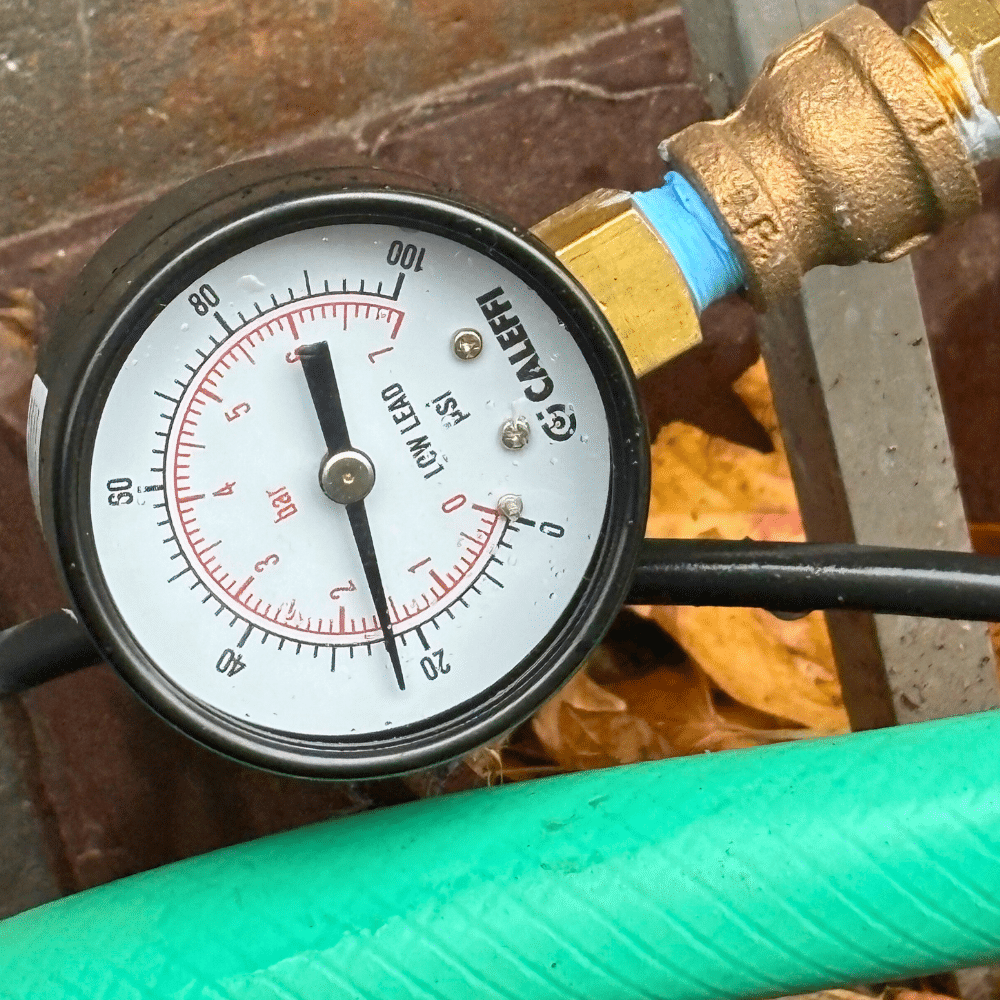
Buy a gauge that screws onto a hose bib. They're under fifteen dollars at any hardware store. Thread it onto an outside faucet or the laundry tub, open the valve all the way, and read it with no water running anywhere in the house.
High pressure doesn't cause every one of these noises, but it makes all of them worse, and it's the one thing you can measure in two minutes. The International Plumbing Code sets the limit at 80 psi static. Above that, a pressure-reducing valve is required, and it has to bring the house down to 80 or less.
Read it in the evening too. City pressure climbs at night when demand drops, and a house that reads 75 psi at dinner can be over 100 psi at 3 a.m. A gauge with a red lazy hand records the overnight peak and costs a few dollars more.
If you're over 80, that's the job, and it comes before anything else. A regulator already on the line can be adjusted: the screw on top turns clockwise to raise pressure and counter-clockwise to lower it. Give it a quarter turn at a time and re-read the gauge, because a worn regulator won't hold a setting and that tells you it needs replacing rather than adjusting.


Banging when water shuts off.
Confirm it before you read further: close the faucet that sets it off fast, then close it slowly. If slow is quiet and fast bangs, it's water hammer and the rest of this section applies.
What's happening is momentum. Water moving in a pipe has to stop somewhere, so it turns into a pressure spike that travels back up the line. The spike is big — in copper, stopping a 5 ft/s flow produces a rise of roughly 276 psi, against valves and fittings the Plumbing and Drainage Institute puts at a 150 psi maximum. That's why hammer loosens joints and kills fill valves over time.
Why the washing machine does it and your hand doesn't
A washing machine or dishwasher uses a solenoid valve that slams shut electrically in a few milliseconds, so it gets the whole surge. Closing a faucet by hand takes most of a second — forty times longer — and the pressure bleeds off as you go.
What sets it off
Of 595 who said when it happened. Some named more than one.
A toilet has no solenoid, and it's still the second most common trigger. Modern fill valves shut off quickly on their own, and on a high-pressure system that's fast enough to do it. If the bang comes as the tank finishes filling, sort the pressure out before you open a wall. Manufacturers make fill valves built for systems with hammer, so ask for one by that description if a standard replacement doesn't settle it. A fill valve that's noisy and also lets the tank refill on its own is a different fault.
Air chambers, and why draining the house doesn't fix them.
Houses built before roughly the 1980s often have air chambers: a capped stub of pipe, 12 to 24 inches, teed off above a fixture supply. The trapped air compresses and absorbs the shock.
The standard advice when they stop working is to shut off the main, open every faucet from the top floor down, drain the system, and close everything back up to restore the air pocket. The Plumbing and Drainage Institute tested this and documented the results in PDI-WH 201, the standard that governs these devices.
Two findings matter.
The first is that air chambers waterlog because water absorbs the air, and they do it quickly. United States Testing Laboratory ran correctly sized chambers on a 50-foot line at 60 psi and 10 ft/s. Every size tested exceeded 150 psi within the first hour, and reached outright failure, described as violent pounding and vibration, between the first and third day. That test cycled the valve about 1,900 times a day, far more than a house sees, so a chamber in a home lasts a good deal longer than that. What it doesn't do is recover. The air dissolves into the water and stays there.
The second finding is more direct. On the popular belief that chambers can be recharged by closing the branch valve and opening the fixtures, the standard states that it is impossible to replenish the air this way. The standard's conclusion is that an air chamber cannot be an effective means of shock control.
Draining the house is still worth doing once, because it costs nothing and it clears trapped air, which makes its own sputtering noise. Just don't expect it to hold. If the bang comes back in a week, the chambers aren't the answer.
Current code no longer accepts a capped stub for new work. The IPC, the IRC and the UPC all require a manufactured arrestor listed to ASSE 1010 wherever quick-closing valves are used.
Putting an arrestor in the right place.
An arrestor is a sealed cylinder with a piston and an O-ring separating a permanent air charge from the water, so there's no air-water surface for the air to dissolve across. That's the whole difference from a capped stub.
What people tried
Of 317 who described a fix attempt. Several tried more than one.
Placement is what makes an arrestor work or fail. Both the IPC and the UPC say to install it as close as possible to the quick-closing valve, and Sioux Chief puts a number on it: within 6 feet of the culprit valve or faucet. One unit at the water main does not protect a house, because residential branch runs are too long and too small for a central device to reach.
Three things from the same spec sheet answer the questions that come up most:
- Any angle. These do not have to stand vertically. An air chamber did, because it relied on air floating on top of water. A piston arrestor has no such requirement.
- No access panel. They're approved for sealed wall installation, so an arrestor behind drywall doesn't need a door cut for it.
- Solder, don't braze. Brazing temperatures destroy the O-ring inside. Sweat fittings are also compatible with press and push-fit connections, which avoids heat entirely.
For sizing, arrestors run AA through F by fixture units, not by pipe size. A single fixture or appliance takes an AA, which covers 1 to 4 fixture units and is what almost every residential job needs. Put one on the hot and one on the cold, since the machine draws from both.
The easiest install is at a washing machine box. Shut both valves, unscrew the hoses, thread a screw-on arrestor onto each valve, and put the hoses back on the arrestors. No pipe work at all.
Both spellings are in use. The codes write arrestor, the manufacturers and the ASSE standard write arrester. Same part.
Humming and vibration.
A steady hum or shudder while water is running is usually not hammer at all. A loose washer inside a valve flutters in the flow, and the pipe run resonates along with it. The pipe is what you hear, but the loose part is what's driving it.
Track it down while the noise is happening. If it hums when a toilet refills, that gives you a long steady window to work in.
- Start flushing the toilet, or open whatever fixture triggers it.
- Go to the shutoff valve feeding that fixture and slowly turn it part way closed, then back open, while the noise is going.
- If the hum changes pitch or stops at some position, that valve is the source.
Tighten the packing nut or the stem first. If it comes back, replace the washer or the whole stop. Angle stops are inexpensive and this is the same repair as any leaking stop.
When no stop changes it, work outward to the whole-house parts. A pressure-reducing valve with a worn seat or diaphragm hums or whistles across its whole flow range, and so does a main shutoff left part way closed. Find your main valve and confirm it's all the way open before you suspect the regulator.
An old toilet with a float ball on an arm is its own case. If the noise stops the moment you hold the arm still, the ball and arm are vibrating, and a modern fill valve replaces the whole assembly.
Whistling and squealing.
A whistle is water forced through a gap that's too small. Find where the gap is by narrowing down how widely it happens.
- One fixture only. A worn stem washer or a scaled cartridge in that faucet. On a two-handle faucet, run each side separately to find which one.
- One toilet only, while the tank fills. Debris in the fill valve, common after any work that disturbed the pipes. Shut the stop, take the cap off the fill valve, hold an upturned cup over the opening, and have someone open the stop for a few seconds to blow the grit clear. Then shut it again and put the cap back.
- Every fixture. The regulator or the main valve, as above.
- Only when a hose or sprinkler runs. Check the vacuum breaker or the anti-siphon valve on that line.
Ticking with hot water.
Ticking or creaking that only follows hot water is thermal expansion. The pipe grows when it heats, drags across a joist or a hanger, and slips in small jumps. Each jump is a tick.
How much it moves depends on the material. Over 100 feet with a 100°F rise, copper grows a little over an inch. CPVC grows about four inches. PEX grows roughly a foot.
| Pipe material | Growth per 100 ft per 100°F |
|---|---|
| Copper | 1.2" |
| CPVC | 4.1" |
| PEX | 12" |
That difference explains why ticking shows up in newer houses. Plastic supply lines move several times as far as copper for the same temperature swing, so they need room to do it.
Strapping the pipe down tighter makes a tick worse rather than better. A pipe clamped hard to a joist still expands, but now it can't slide freely, so the stress builds and then releases all at once. The Plastics Pipe Institute is explicit that PEX should not be rigidly anchored, and calls for about 1/8 inch of slack per foot of run.
Where you can reach the pipe, the fix is to give it a smooth surface to move on rather than to pin it down: felt or foam sleeve where it passes through a joist hole, and hangers loose enough to let it slide. Where it's buried in a wall, you're choosing between opening the wall and living with the tick.
Rattling in a wall.
A rattle or a clatter is pipe hitting framing. Loose pipe doesn't create the force, it just transmits it, so a rattle usually means you also have hammer or high pressure driving it. Fix the pressure first or the rattle comes back somewhere else.
Where the pipe is reachable in a basement or crawl space, add a strap or a cushioned clamp every few feet, and shim any gap where a pipe passes through a hole with room to move. Copper against a steel hanger needs an isolator between them, both for the noise and because the two metals in contact corrode.
A hiss with nothing running is not a noise problem.
If you can hear water moving when every fixture in the house is off, that's water going somewhere. Treat it as a leak.
Check the meter. Shut every fixture, find the meter, and watch the low-flow indicator, which is usually a small triangle or dial that spins on tiny flows. If it moves at all, water is leaving the system.
A running toilet is the first thing to rule out, since it's silent at the fixture and constant at the meter. Shut the stop at each toilet in turn and watch the meter again.
A hiss that turns out not to be a leak is usually a valve not quite closed, or a water heater's relief line weeping. Both are worth finding, because a relief valve discharging means a pressure or temperature problem that should not be left alone.
When it's a call, not a repair.
- Pressure reads over 80 psi and there's no regulator on the house. Installing one means cutting into the main line inside the building.
- Pressure is over 80 with a regulator fitted, and adjusting it doesn't hold. It's failed and needs replacing.
- The banging is in a wall or a slab and the arrestor at the appliance didn't stop it.
- Pipes came loose behind finished walls and there's no access to strap them.
- The meter confirms water moving with everything off and no toilet or fixture accounts for it.
- A relief valve or a pressure gauge is showing spikes well above supply pressure, which points at a closed system with no expansion control.
Water pressure testing ↗ · PRV repair and replacement ↗ · Find your main water shutoff ↗
Where the numbers come from: 887 homeowner questions about noisy water pipes posted to public plumbing forums, scoped to threads about a noise in the supply plumbing rather than heating systems, well pumps, water softeners or drain noise, and sorted by what each person described. Because they count what people wrote down, each figure is a floor, not a census. Technical sources: PDI-WH 201 (revised 2017) from the Plumbing and Drainage Institute for the air chamber failure testing by United States Testing Laboratory, the finding that air chambers cannot be replenished by draining, the AA–F sizing classes and the 150 psi component rating; International Plumbing Code 604.8 for the 80 psi static limit and 604.9 for the arrestor requirement and ASSE 1010 listing, with the matching provisions at IRC P2903.5 and UPC 609.10; Sioux Chief's 660 Series specification sheet for the 6-foot placement, any-angle mounting, sealed-wall approval, fixture-unit range and the instruction not to braze; the Plastics Pipe Institute's PEX Plumbing Design and Installation Guide for the expansion rate, the slack allowance and the warning against rigid anchoring; published Joukowsky surge calculations for the pressure rise and wave speed figures. Every procedure here was checked against those documents.