Two things go wrong with main shutoffs that most advice skips. The valve you find in the yard usually isn't your house shutoff, and the real one has a habit of leaking the first time you turn it after twenty years.
Finding the right valve and testing it are both worth doing on a dry Saturday rather than at midnight with water coming through a ceiling.
If water is coming in while you read this: close the main, open the lowest faucet in the house, then one on the top floor, and switch the water heater off if you are draining the system. Everything below is for working this out beforehand.
The valve in your yard is probably the sprinklers.
This one is specific to how homes here are plumbed, and it catches people constantly. If you have a round cap in the lawn somewhere between the water meter and the house, and a long T-shaped key to turn it, that is almost certainly a stop and waste valve — and along the Wasatch Front it is nearly always the irrigation shutoff, not the house shutoff.
It is tapped off the main line on its way to the house and feeds the sprinkler system only. Closing it isolates the sprinklers and drains the line so it doesn't freeze, which is the "waste" half of the name. It does nothing for the water inside your house. Because our frost line is deep, these sit roughly three to seven feet down, with only the access tube reaching the surface.
If you close the stop and waste and water still runs indoors, nothing is broken. You closed the sprinkler valve. Your house shutoff is somewhere else, almost always inside.
Three more things that are not your house shutoff.
| What it is | Why people try it | Why it isn't the answer |
|---|---|---|
| The meter valve, out at the street | It's obviously on the water line | That side belongs to the utility. In Salt Lake City the meter and its yoke and valve sit in the parking strip as part of the city's service connection, and the city maintains the connection up to and including the meter on standard 3/4" and 1" services |
| The pressure regulator's adjustment screw | It's a fitting near the main with a bolt on top | It changes the pressure setting. It does not stop flow, and messing with it will cost you a regulator |
| The water heater's relief valve lever | It's a lever, and lifting it makes water come out | That's a safety device. Using it as a drain or a shutoff is how a weeping T&P valve starts |
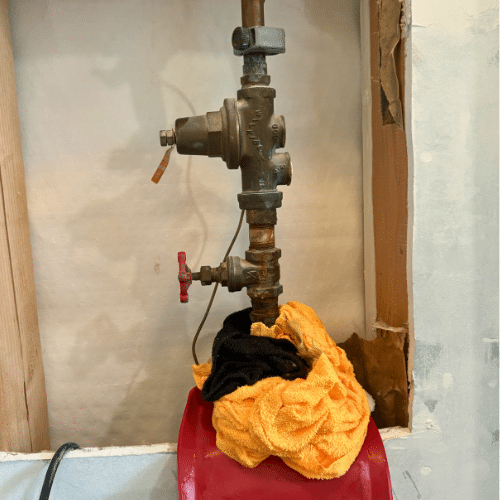
Start instead where the water line enters the house — along the basement foundation wall in most valley homes, in a garage or a utility closet in a slab house. Follow the pipe from where it comes through the wall. The first full-size valve on it is the one you want. In a finished basement it may be behind an access panel.
How these valves actually fail.
What went wrong, in people's own words
Of 36 people who described how their main shutoff failed. Bars show the number of people.
That top bar is the whole point of this guide. The most common bad outcome is not a valve that refuses to move — it's a valve that moves and then starts leaking, usually at the packing nut around the stem. A valve that has sat in one position since the house was built has corrosion and hardened packing holding it still. Turning it breaks that seal.
So the standard advice to "exercise your shutoff once a year" comes with a condition nobody mentions: only do it when you could tolerate it leaking. Not the night before you travel.

Read the handle before you touch it.
What people had
Of 47 people who said which kind. Some houses have more than one.
- Lever handle. A ball valve. It moves a quarter turn and no further. Handle in line with the pipe is open; handle across the pipe is closed. If it stops halfway, stop pushing — you're about to snap the stem.
- Round wheel handle. A gate valve, and it's the one that lets people down. It takes many turns, and an old one very often will not seal completely even when it's wound fully shut. A gate valve that leaves a trickle is not a valve you can rely on for a repair.
Knowing which you have changes your plan. If your only house shutoff is an old gate valve, the honest answer is that you do not currently have a dependable way to isolate your house, and replacing it is worth doing before you need it — not during.
Testing it without creating the emergency.
Nearly half the people in this data had already replaced a valve or part by the time they were asking for help. Some of that started as a routine test that went wrong. If you are going to turn yours, stack the odds first.
- Pick your moment. A weekday morning, nobody showering, supply houses open. Not a holiday weekend.
- Know the fallback before you start. If your valve fails open and you can't stop the water, the next call is the utility, not a search engine. Salt Lake City Public Utilities run a 24-hour emergency dispatch on (801) 483-6700. Their main customer service line, (801) 483-6900, is weekdays 8 to 5 — save the dispatch number instead, because this will not happen on a Tuesday afternoon. If you're outside the city, find your own water provider's after-hours number tonight and put it in your phone.
- Open a low faucet first and leave it running. It gives you an obvious signal and somewhere for pressure to go.
- Turn it slowly and watch the stem, not the handle. Weeping around the packing nut is the failure you're looking for. A small weep will often stop with an eighth of a turn on the packing nut. An eighth of a turn, not a heave on the wrench.
- Check that it actually closed. The open faucet should die to nothing. Pressure takes a moment to bleed down, so give it thirty seconds. A faucet that keeps dribbling means the valve is not sealing, which is a result worth knowing.
- Open it slowly again and leave a faucet open while you do, so the system refills without a slug of air and a pressure spike.
When water is actually running, the order matters.
Closing the valve is only the first move, and on its own it doesn't stop the water. Everything already in the pipes above the break still has to come out somewhere, and by default that somewhere is your ceiling.
- Close the main. Slowly if it will let you, fast if it won't.
- Open the lowest faucet in the house — a basement sink, a laundry tub, an outside hose bib. That gives the water in the pipes a path down and out that isn't through the break.
- Then open a faucet on the top floor to let air in behind it. Without that, the system holds a vacuum and drains slowly.
- Leave the leak itself alone while it drains. Put a bucket and towels under it and let the pressure go first.
If you are going to drain the system right down, kill the water heater first. An electric heater with power on and no water in it burns its elements out in minutes. Switch it off at the breaker. A gas heater goes to its pilot or vacation setting. Simply closing the main doesn't create this problem — the tank stays full — but opening a low faucet and walking away can.
Using the meter to find out where the leak is.
If the bill jumped and nothing is visibly wet, the meter will tell you which side of the house the problem is on — and it does it using the two valves you've just identified. Most residential meters have a small triangular or star-shaped low-flow indicator that turns on the tiniest flow, far below what the main dial shows.
- Shut off everything that uses water — taps, the washing machine, the dishwasher, the ice maker, the irrigation controller. Then watch the low-flow indicator. If it's turning, water is going somewhere.
- If it isn't turning, write the reading down and don't use any water for two hours. Come back and read it again. If it changed, you have a slow leak. The EPA's caveat is worth knowing: if your meter reads in cubic feet rather than gallons, a small leak may not move it in two hours.
- Now close the house shutoff and go back to the meter. If the indicator stops, the leak is inside the house. A toilet is the first place to look.
- If it keeps turning with the house isolated, the water is escaping between the meter and that valve — the buried service line, or anything teed off it. Which brings you back to the sprinkler valve.
- Close the stop and waste as well. If the indicator stops now, it's the irrigation system. If it still turns with both valves shut, you have a leak in the service line itself, and that's a dig.
That sequence is worth running before anyone starts opening walls, because it narrows an invisible leak down to one of three places in about ten minutes.
Then leave a clue for whoever's next.
You will not be the person who needs this. It will be a house-sitter, or your kid, or you at 3am when you are not thinking clearly.
Label the valve. Keep the path to it clear — not behind the Christmas boxes. Take two photos, one wide enough to show where in the room it is and one close enough to show which way the handle goes, and put them somewhere the whole household can find. Tell everyone who lives there. And if you needed a key to reach the stop and waste, hang it somewhere obvious rather than wherever it ended up after winterizing.
Where to hand it over.
- You cannot find any house shutoff, or the only one you have is an old gate valve that won't seal.
- The valve leaks at the stem and tightening the packing nut didn't stop it.
- The handle spun free, snapped, or the stem sheared.
- The pipe at the valve is galvanized and visibly corroded — an 80-year-old main into the house does not react well to being disturbed.
- The meter keeps running with both the house valve and the sprinkler valve closed. That's the buried service line.
- The only working shutoff is on the city's side of the meter. That's a call to the utility, not a DIY job.
How main shutoff replacement works ↗ · All shutoff valve repair ↗ · Testing your water pressure ↗ · A toilet that refills by itself ↗
Where the numbers come from: 133 homeowner questions about main house shutoffs posted to public plumbing forums, scoped to the whole-house valve rather than fixture stops, and sorted by what each person described. The counts are small and are shown as counts for that reason; they indicate what tends to go wrong, not how often it happens per house. Local and code sources: Salt Lake City Code 17.16.220 and 17.16.400 on service connections, meter ownership and maintenance; Salt Lake City Department of Public Utilities published customer service and 24-hour emergency dispatch numbers, confirmed against their Utilities and Services page. The meter leak-isolation sequence and the two-hour meter test, including the cubic-feet caveat, follow the US EPA WaterSense "Detect and Chase Down Leaks" checklist and standard utility leak-location procedure. Stop and waste valve depth, function and operation reflect standard Wasatch Front irrigation practice. Every procedure here was checked against those sources.